Andhra Pradesh Adangal Online – How to Check Agricultural Land and Cultivation Details
Land records are important for farmers, landholders, buyers and families managing agricultural property in Andhra Pradesh. Among the different revenue records used in the state, Adangal, also commonly referred to as Pahani in land-record services, is an important document for checking information related to agricultural land.
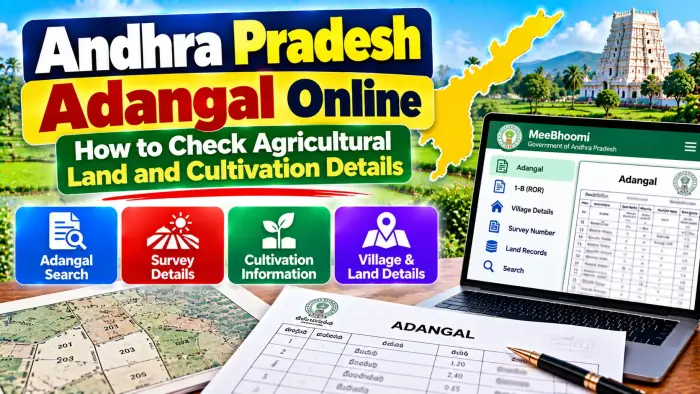
With digital land-record services such as MeeBhoomi, users can access available land information online by using property details such as district, Mandal, village and survey number.
An Adangal can contain useful information relating to a land parcel, including recorded landholder details, extent, survey information, cultivation-related information, source of irrigation and other revenue-record particulars.
If you want to understand Andhra Pradesh Adangal Online, this guide explains what an Adangal is, what information it may contain, how to check available land records online and what you should verify before using the information for an important purpose.
Andhra Pradesh Adangal Online – Quick Overview
| Details | Information |
|---|---|
| State | Andhra Pradesh |
| Important Record | Adangal / Pahani |
| Land Record Platform | MeeBhoomi |
| Main Purpose | Agricultural land information |
| Main Identifier | Survey Number |
| Location Details | District, Mandal and Village |
| Landholder Details | May be available |
| Land Extent | May be recorded |
| Cultivation Details | Part of applicable land records |
| Irrigation Source | May be recorded |
| Soil Classification | May be available |
| Related Record | ROR / 1B |
| Survey Maps | Bhunaksha / Survey Records |
| Official Copies | May require applicable government service |
What Is Adangal in Andhra Pradesh?
Adangal is an important village-level revenue record associated with land in Andhra Pradesh.
It is particularly useful for agricultural land because the record can contain information relating to the land parcel and cultivation.
Government service documentation describes Adangal/Pahani as an important document containing details such as the landholder's name, extent, Khata information, survey and Hissa number, land revenue details, source of cultivation, nature of possession, method through which the land was acquired, certain rights or liabilities and soil classification.
The exact information visible in a digital record can depend on the data available for the selected land parcel.
Is Adangal the Same as Pahani?
The terms Adangal and Pahani are commonly encountered together in Andhra Pradesh revenue services.
Government service documentation also refers to the service as Adangal/Pahani.
The document is associated with land and cultivation-related revenue information.
However, users should not confuse Adangal with every other land document. A registered sale deed, Record of Rights, Pattadar Passbook, FMB and cadastral map each serve different purposes.
Therefore, complete property verification may require checking more than one record.
What Is MeeBhoomi?
MeeBhoomi is Andhra Pradesh's online land-record platform.
It was introduced to make land-record information more accessible digitally. Government district websites direct citizens to MeeBhoomi for applicable land-record services.
Through the state's digital land-record system, users can check available information associated with their property instead of relying entirely on manual searches at government offices.
The services and interface can be updated over time, so users should follow the options currently displayed on the official land-record platform.
What Information Can an Adangal Contain?
An Adangal can provide several important details about agricultural land.
Depending on the applicable record, users may find information relating to the recorded landholder, Khata, total land extent, survey number, Hissa or subdivision, land revenue, cultivation source, nature of possession, soil classification and certain rights or liabilities associated with the land.
Revenue administration in Andhra Pradesh also maintains survey-number-wise information relating to crops and irrigation sources.
This makes Adangal useful when a person wants to understand the revenue record associated with agricultural land.
Details Required to Check Adangal Online
Before searching for an Adangal, collect the correct location and property information.
Useful details can include:
District
Mandal
Village
Survey Number
Subdivision or Hissa Number, where applicable
Khata or landholder information, where available
You can usually find these details in an existing registered deed, Pattadar Passbook, ROR/1B, previous Adangal or another land document.
Entering the correct village and survey number is particularly important because similar survey numbers can exist in different villages.
How to Check Andhra Pradesh Adangal Online
Start with the official Andhra Pradesh land-record service.
Choose the applicable Adangal or land-information option available on the system.
Select the correct district, Mandal and village.
Enter the survey number or other property information requested on the screen.
If your property has a subdivision or Hissa number, make sure you select or enter the correct reference.
Complete the verification process shown by the system and submit your search.
Review the displayed information carefully and compare it with your existing land documents.
The exact navigation and available search fields can change when the government updates its online services.
How to Check Agricultural Land Details
Agricultural land should be identified using the complete survey reference and location information.
After finding the applicable record, check the land extent and other recorded particulars.
Compare these details with your Pattadar Passbook, registered deed and ROR information.
If the survey number is divided into multiple subdivisions, make sure the displayed land relates to the correct subdivision.
A difference of even one subdivision reference can lead to information relating to another portion of the survey parcel.
How to Check Cultivation Details
Adangal is particularly relevant when checking cultivation-related land information.
Revenue administration can maintain information about crops cultivated against survey numbers and sources of irrigation.
Depending on the applicable record and the period for which data is maintained, cultivation-related entries can help users understand how agricultural land has been recorded.
However, cultivation information can change from one season or period to another.
Therefore, users should pay attention to the relevant record period rather than assuming that an older cultivation entry describes the current crop.
Check Survey Number Carefully
The survey number is one of the most important identifiers in Andhra Pradesh land records.
It identifies the relevant parcel within the applicable survey and village records.
A survey number can also have subdivisions or Hissa numbers.
For example, different portions of an original survey parcel may have separate subdivision references.
When comparing Adangal information with a deed or Pattadar Passbook, check the complete survey and subdivision reference rather than relying only on the main survey number.
What Is a Khata Number?
Khata information can also appear in land records.
It helps connect the applicable landholding information with the relevant recorded account or landholder information within the revenue system.
An Adangal/Pahani may include the landholder's name along with extent and Khata-related information.
When reviewing a record, compare the Khata and survey information with other available land documents.
A mismatch should be investigated before the record is used for an important transaction.
Adangal vs ROR-1B
Adangal and ROR/1B are related to land records but should not automatically be treated as identical documents.
Adangal is particularly useful for parcel and cultivation-related revenue information.
ROR or Record of Rights information focuses on the rights recorded in relation to land.
When verifying agricultural property, checking both records can provide a broader understanding of the available revenue information.
For important ownership verification, registered documents should also be examined.
Adangal vs Pattadar Passbook
A Pattadar Passbook is another important document associated with landholding in Andhra Pradesh.
Adangal, on the other hand, provides land and cultivation-related revenue information.
The two records can therefore complement each other.
When checking property, compare the pattadar details, survey number, subdivision, land extent and other information appearing across available records.
If there is a significant mismatch, contact the appropriate Revenue authority for clarification.
Adangal and Agricultural Loans
Land records can sometimes be required when a person applies for an agricultural loan or another land-related government or financial service.
The exact documents accepted depend on the bank, department or scheme.
An Adangal may be requested as supporting evidence in some situations, but users should not assume that an online screenshot alone will satisfy every requirement.
Check whether the organization requires a current, digitally issued, certified or otherwise officially accepted record.
How to Check Land Maps
For map-related information, Andhra Pradesh also provides the Bhunaksha cadastral mapping system.
Bhunaksha is connected with land-map and spatial information and integrates with existing land-record systems.
A cadastral map can help users understand the recorded location and shape of a parcel.
However, a digital map should not be treated as a replacement for an official field survey when there is a physical boundary dispute.
What If Adangal Information Is Incorrect?
If the recorded name, survey number, subdivision, extent or other important information appears incorrect, first compare it with your registered deed, Pattadar Passbook, ROR and other available records.
Determine whether the issue exists only in one record or across multiple land records.
Correction of an official revenue record can require verification by the appropriate authority.
Supporting documents may be required depending on the type of correction.
Do not rely on unofficial websites or agents claiming that they can instantly modify government land records.
Is Adangal Proof of Legal Ownership?
Adangal is an important revenue record, but it should not be used alone to reach a final conclusion about legal ownership.
Complete title verification may require registered sale deeds, gift or inheritance documents, Record of Rights information, mutation records, Pattadar Passbook details, court orders and other relevant documents.
This is especially important before buying agricultural land.
An online land-record search is useful for preliminary verification, but major property transactions may require certified records and appropriate legal verification.
Frequently Asked Questions (FAQ)
1. What is Andhra Pradesh Adangal?
Adangal is an important revenue record containing applicable information about land, the recorded holder and agricultural or cultivation-related details.
2. Is Adangal also called Pahani?
Government service documentation commonly refers to the record as Adangal/Pahani.
3. Where can I check Andhra Pradesh land records?
MeeBhoomi is the state's online land-record platform used for accessing applicable land information.
4. What details are needed to search an Adangal?
District, Mandal, village and survey number are important. Subdivision or Hissa details may also be required.
5. Does Adangal show cultivation information?
Adangal is associated with agricultural and cultivation-related revenue information, subject to the details maintained in the applicable record.
6. Can Adangal contain the landholder's name?
Yes. Applicable Adangal/Pahani records can contain landholder information along with land extent and other particulars.
7. What is a survey number?
A survey number is an identifier used to identify land within the relevant village and survey records.
8. Is Adangal the same as ROR-1B?
No. They are related land records but serve different record-keeping purposes.
9. Can I use Adangal to check agricultural land before purchase?
Yes, it can be part of preliminary verification, but registered deeds and other relevant records should also be checked.
10. Does an online Adangal prove ownership?
Not by itself. Complete ownership verification may require registered documents, ROR information and other applicable records.
Conclusion
Andhra Pradesh Adangal Online provides a convenient way to review important agricultural land and cultivation-related revenue information. By using the correct district, Mandal, village, survey number and subdivision details, users can locate the applicable land record and compare it with existing property documents.
Adangal/Pahani can contain information such as the recorded landholder, land extent, survey and Hissa number, cultivation-related details, irrigation source and soil classification. Other records such as ROR/1B, Pattadar Passbook, survey maps and registered deeds can provide additional information.
For important matters such as buying agricultural land, inheritance, loans or disputes, do not depend on a single online record. Compare the Adangal with other official land and registration documents and obtain certified or professionally verified records where necessary.