Andhra Pradesh ROR 1-B Online – How to Check Land Ownership and Khata Information
Checking land records is an important step for farmers, property owners, buyers and families dealing with agricultural land in Andhra Pradesh. One of the important revenue records used in the state is ROR 1-B, which forms part of the Record of Rights system.
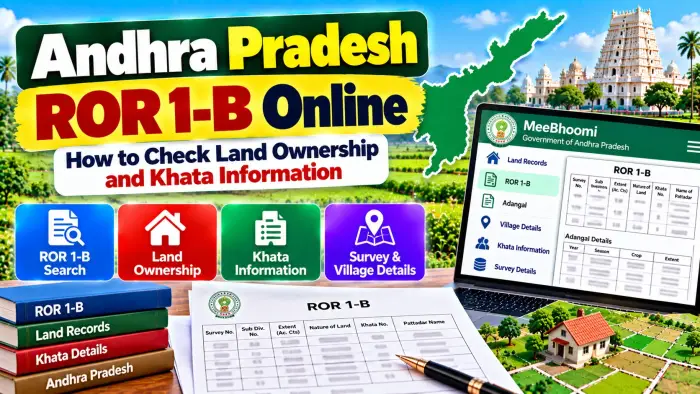
The ROR 1-B record can provide important information about land and the person recorded against it. Details may include the khatadar's name, Khata number, survey number, land classification, extent and other revenue-related information.
Andhra Pradesh has also digitized many land-record services. Through systems such as MeeBhoomi and applicable Revenue Department services, citizens can access available land information without depending entirely on manual searches at government offices.
This guide explains Andhra Pradesh ROR 1-B Online, how to check land ownership and Khata information, what details are required and what you should verify before using a land record for an important property transaction.
Andhra Pradesh ROR 1-B – Quick Overview
| Details | Information |
|---|---|
| State | Andhra Pradesh |
| Record Name | ROR 1-B |
| Full Form | Record of Rights 1-B |
| Land Record Platform | MeeBhoomi |
| Record Maintained At | Village/Revenue level |
| Important Identifier | Khata Number |
| Parcel Identifier | Survey Number |
| Recorded Holder | Khatadar details |
| Land Extent | May be included |
| Land Classification | May be included |
| Related Record | Adangal / Pahani |
| Survey Maps | Bhunaksha / Survey Records |
| Correction | Applicable Revenue process |
| Ownership Verification | Check supporting legal records |
What Is ROR 1-B in Andhra Pradesh?
ROR stands for Record of Rights. The ROR 1-B is an important land-revenue record used in Andhra Pradesh.
The Record of Rights register is maintained village-wise under the Revenue administration. It contains information relating to the land and the persons whose rights are recorded against it.
An ROR 1-B record can include details such as the name of the khatadar, father's name, Khata number, survey number, classification of land, extent held by the khatadar and applicable land-revenue information.
Because it brings together several important land details, ROR 1-B is useful when checking the revenue record associated with a property.
What Is MeeBhoomi?
MeeBhoomi is Andhra Pradesh's online land-record platform.
It allows citizens to access available land information digitally. Andhra Pradesh government district websites direct users to MeeBhoomi for checking land records.
The digital system can make it easier for landholders to review their property information without visiting an office for every basic land-record enquiry.
However, the services and interface can change. Users should therefore follow the options currently displayed on the official land-record system.
What Is a Khata Number?
A Khata number is an important reference used in the revenue land-record system.
It helps connect the recorded landholding with the relevant khatadar or account in the revenue records.
When checking an ROR 1-B, the Khata number can be used along with the survey number and location information to understand which landholding the record relates to.
A Khata number should not be confused with a survey number. They perform different functions in land records.
Khata Number vs Survey Number
A survey number identifies a particular land parcel or survey unit within the applicable village and survey records.
A Khata number relates to the landholding or account associated with the recorded khatadar in the revenue system.
Depending on the record, one Khata may be associated with more than one survey parcel.
Therefore, when checking a property, compare both the Khata and survey details instead of relying on only one number.
What Information Can ROR 1-B Contain?
The ROR 1-B can contain several important details connected with a landholding.
Depending on the applicable record, these can include the khatadar's name, father's name, Khata number, survey number, land classification, extent and revenue-related information.
The information can help a landholder understand how the property is currently reflected in the revenue record.
However, the exact fields and digital presentation may change depending on the current government system.
Details Required to Check ROR 1-B
Before starting your search, collect the available information from your existing property documents.
Useful details may include:
District
Mandal
Village
Khata Number
Survey Number
Subdivision number, where applicable
Pattadar or khatadar details
These details may be available in an old ROR 1-B, Adangal, Pattadar Passbook, registered deed or another land document.
Always select the correct village because similar Khata or survey numbers can exist in different locations.
How to Check Andhra Pradesh ROR 1-B Online
Start with the official Andhra Pradesh land-record service.
Select the applicable ROR or land-record option available on the system.
Choose the correct district, Mandal and village.
Enter the Khata number, survey number or other information requested by the system.
Complete any verification shown on the screen and submit the search.
Review the displayed ROR information carefully.
Compare the result with your existing deed, Pattadar Passbook and other land documents before using the information for an important purpose.
How to Check Land Ownership Information
ROR 1-B can help you check who is recorded as the khatadar against the applicable land record.
Start by identifying the correct village and land parcel. Then compare the recorded name, Khata number, survey number and land extent with the documents in your possession.
If the information matches, it can provide useful confirmation of the current revenue-record entry.
However, the recorded name in ROR 1-B should not automatically be treated as conclusive legal title.
Ownership verification can require additional documents.
ROR 1-B and Adangal – What Is the Difference?
ROR 1-B and Adangal are both important revenue records, but they serve somewhat different record-keeping purposes.
ROR 1-B focuses on Record of Rights information and the applicable landholding.
Adangal/Pahani can contain parcel and cultivation-related details, including agricultural information associated with land.
When checking agricultural property, comparing both ROR 1-B and Adangal can provide a broader view of the available revenue information.
ROR 1-B and Pattadar Passbook
The Pattadar Passbook is another important land-related document in Andhra Pradesh.
It is associated with the recorded landholder and relevant property information.
When reviewing ROR 1-B, compare the khatadar name, Khata number, survey number and land extent with the details in the Pattadar Passbook.
A significant mismatch between the records should be investigated before the property is sold, purchased or used for an important application.
ROR 1-B for Agricultural Land
ROR 1-B can be particularly useful for people dealing with agricultural land.
The record can help identify the person recorded against the land, survey details, extent and classification.
For cultivation-related information, users may also need to examine the applicable Adangal/Pahani.
For survey boundaries or measurement-related information, FMB or other survey records may also be relevant.
Using the correct record for the correct purpose is important when verifying agricultural property.
Can You Obtain an ROR 1-B Document?
Andhra Pradesh's government service system lists ROR 1-B as a Revenue service.
Depending on the current service channel, users may be able to retrieve or request an ROR 1-B document.
Government service documentation indicates that digitally signed ROR 1-B records may be printable through the applicable service workflow, while records requiring approval can go through the prescribed Revenue process.
Always distinguish between viewing basic online information and obtaining an officially issued or digitally signed record.
What If ROR 1-B Information Is Incorrect?
If the name, Khata number, survey number, extent or another important entry appears incorrect, compare the ROR 1-B with your registered deed, Adangal, Pattadar Passbook and other official documents.
Andhra Pradesh's government service system includes a process for rectification of entries in ROR 1-B.
Correction is not simply a matter of manually editing the online record.
The appropriate Revenue authority may need to verify the documents and approve the correction according to the applicable process.
Mutation and ROR 1-B
Mutation is relevant when applicable landholding information changes after a qualifying transaction or event.
For example, a sale, inheritance, gift or other legally recognized transfer can require an update to the revenue record.
If the mutation process has not been completed, an older khatadar's details may continue to appear in the land records.
After an applicable mutation is completed, check the ROR 1-B again to verify the updated revenue information.
Check ROR 1-B Before Buying Land
ROR 1-B can be useful when carrying out preliminary verification before purchasing land.
Compare the seller's details with the available ROR record.
Check the Khata number, survey number, subdivision, extent and land classification.
Also compare the information with the registered deed, Adangal/Pahani, Pattadar Passbook and applicable survey records.
For a significant property transaction, additional checks such as registration records and encumbrance information may also be appropriate.
Can ROR 1-B Prove Legal Ownership?
ROR 1-B is an important revenue record, but it should not be relied upon alone as final proof of legal ownership.
Property rights may arise through registered purchase, inheritance, gift, partition, settlement, court decree or other legally recognized methods.
Therefore, complete title verification may require registered deeds, inheritance documents, mutation records, ROR information, court orders and other applicable records.
This is especially important when purchasing land or dealing with a property dispute.
ROR 1-B and Land Maps
For spatial and map-related information, Andhra Pradesh also provides land survey and cadastral-map systems.
Bhunaksha is used for cadastral mapping and is integrated with Andhra Pradesh's land-record ecosystem.
A land map can help users understand the recorded parcel location and boundaries.
However, online maps should not replace an official physical survey or demarcation where a boundary dispute exists.
Safety Tips While Checking ROR 1-B
Use official Andhra Pradesh government land-record and Revenue services.
Avoid unknown websites claiming that they can change the khatadar name or guarantee a land-record correction immediately.
Do not share ATM PINs, UPI PINs, CVV numbers or banking passwords merely to access land records.
Keep copies of your registered deed, Pattadar Passbook, ROR, Adangal and important application acknowledgements safely.
Frequently Asked Questions (FAQ)
1. What is Andhra Pradesh ROR 1-B?
ROR 1-B is a Record of Rights land-revenue record containing applicable information about the recorded khatadar and landholding.
2. What information can ROR 1-B contain?
It can include khatadar name, Khata number, survey number, land classification, extent and other revenue information.
3. Where can I check Andhra Pradesh land records?
MeeBhoomi is used as an online land-record platform for Andhra Pradesh.
4. What is a Khata number?
A Khata number is a revenue-record reference associated with the applicable landholding or recorded account.
5. Is a Khata number the same as a survey number?
No. A survey number identifies a land parcel, while a Khata number relates to the applicable landholding account.
6. Can ROR 1-B show the landholder's name?
Yes. The record can contain the name of the recorded khatadar and related information.
7. Is ROR 1-B the same as Adangal?
No. Both are revenue records, but Adangal is particularly associated with parcel and cultivation-related information.
8. Can incorrect ROR 1-B entries be corrected?
Andhra Pradesh provides an applicable Revenue process for rectification of ROR 1-B entries.
9. Should I check ROR 1-B before buying land?
It can be useful for preliminary verification, but other land, registration and legal documents should also be checked.
10. Does ROR 1-B alone prove legal ownership?
No. It is an important revenue record, but complete legal title verification may require registered deeds and other applicable documents.
Conclusion
Andhra Pradesh ROR 1-B Online makes it easier to review important landholding and Khata information through the state's digital land-record system. ROR 1-B can contain details such as the recorded khatadar's name, Khata number, survey number, land classification and extent.
When checking a property, use the correct district, Mandal, village, Khata and survey details. Compare the ROR 1-B with the Adangal/Pahani, Pattadar Passbook, registered deed and relevant survey records.
Most importantly, treat ROR 1-B as an important revenue record rather than standalone proof of legal ownership. For property purchases, inheritance matters, disputes or other major transactions, all relevant land and registration documents should be checked together.