AnyRoR Gujarat Survey Number Search – How to Find Your Land Records Online
Finding the correct land record is important for farmers, landowners, property buyers and legal heirs in Gujarat. One of the most useful details for identifying a rural land parcel is the Survey Number. Gujarat's computerized land-record system allows users to search applicable village land information using survey and other property details.
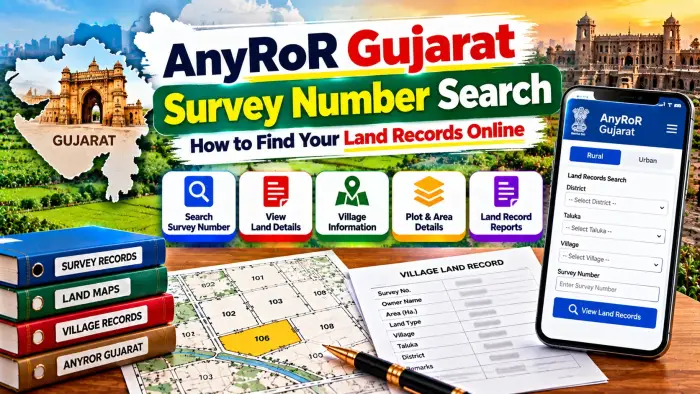
The AnyRoR Gujarat Survey Number Search can help users check available land records without relying only on old paper copies. Gujarat's e-Dhara system has computerized village land records and supports searches using Survey Number, Khata Number, Khatedar name and other land information.
Different records provide different types of information. For example, VF7/12 is associated with survey-parcel information, VF8A focuses on Khata or land-account details, while VF6 is important for mutation entries.
This guide explains how to search Gujarat land records using a Survey Number, what information you should keep ready and how to compare different records for better property verification.
AnyRoR Gujarat Survey Number Search – Quick Overview
| Details | Information |
|---|---|
| State | Gujarat |
| Land Record System | AnyRoR / e-Dhara |
| Search Type | Survey Number Search |
| Area Covered | Applicable Rural Land |
| Main Identifier | Survey Number |
| Other Identifier | Block Number, where applicable |
| Land Account Record | VF8A |
| Survey/Parcel Record | VF7/12 |
| Mutation Record | VF6 |
| Location Details | District, Taluka and Village |
| Landholder Search | Khatedar Name |
| Account Search | Khata Number |
| Record Category | Record of Rights |
| Official Copy | Available through applicable e-Dhara/eGram services |
| Ownership Verification | Compare with registered documents |
What Is AnyRoR Gujarat?
AnyRoR is Gujarat's digital land-record facility for accessing applicable Record of Rights information.
It is part of the state's broader computerized land-record ecosystem.
The e-Dhara project was created to convert physical village land records into electronic records and provide a more transparent method for maintaining, updating and accessing land information.
For rural properties, users can check different Village Forms depending on the type of information required.
This digital system makes it easier to locate land records using important identifiers such as Survey Number and Khata Number.
What Is a Survey Number?
A Survey Number is an important identification number assigned to a surveyed parcel or field within the relevant land-record system.
It helps connect a particular parcel with its official survey and revenue information.
A Survey Number should always be read together with the property's location.
For example, simply knowing “Survey No. 100” is not enough to identify a property across Gujarat because the same numerical Survey Number may exist in different villages.
You should therefore confirm the District, Taluka and Village along with the Survey Number.
Why Is Survey Number Important?
The Survey Number acts as a key reference when checking parcel-specific land records.
It can help users locate the applicable Record of Rights and compare land information with registered documents.
A Survey Number is also useful when examining mutation history, Khata information and older land records.
If you are planning to purchase rural land, the Survey Number mentioned in the property documents should be carefully compared with the current land records.
Incorrect or incomplete survey information can lead to checking the wrong parcel.
What Is a Block Number?
In some land records, users may encounter a Block Number in addition to or instead of an older Survey Number reference.
Land records can contain different identifiers depending on survey, consolidation or other administrative processes.
If your registered deed mentions both an old Survey Number and a Block Number, compare those references carefully with the current revenue record.
Do not assume that an old Survey Number and a current Block Number can be used interchangeably without verification.
What Information Can You Find Using Survey Number?
A Survey Number search can help locate parcel-related information available in the applicable land record.
Depending on the record selected, users may be able to review information connected with the land parcel, recorded landholder, area, land type, rights, cultivation or other revenue details.
The exact information varies according to the Village Form.
For example, VF7/12 is more relevant for parcel-related land information, while VF8A is useful for understanding the associated Khata or land account.
Details Required for AnyRoR Survey Number Search
Before beginning your search, keep the relevant property information ready.
Important details can include:
District
Taluka
Village
Survey Number
Block Number, where applicable
Khata Number, if known
Khatedar or landholder name
These details may be available in an older 7/12 record, VF8A, registered deed, mutation document or another official land record.
Check the spelling of the village and make sure you are searching within the correct administrative location.
How to Search Gujarat Land Records by Survey Number
Start with Gujarat's official land-record viewing service.
Choose the option for rural land records.
Select the applicable record or Survey Number-related search.
Choose the correct District.
Next, select the Taluka and Village where the land is located.
Enter or select the Survey Number or other requested parcel details.
Complete the verification displayed by the system.
Submit the search.
Review the available land-record information carefully.
Government portals can change their layout and search options over time, so always follow the instructions currently displayed by the official service.
What Is VF7/12?
VF7/12 is one of the most commonly checked rural land records in Gujarat.
It is closely associated with a particular survey parcel and can provide important revenue and agricultural information.
When searching by Survey Number, VF7/12 can be especially useful because it connects the selected parcel with the available land-record details.
Always make sure the Survey or Block Number in the record matches the number mentioned in the property documents you are checking.
Survey Number and VF8A Khata
VF8A serves a different purpose from parcel-focused records.
It is associated with Khata or land-account information.
A single Khata can be connected with one or more land parcels depending on the recorded landholding.
Therefore, after identifying a parcel through its Survey Number, checking the related Khata can provide additional information about the recorded land account.
The Survey Number and Khata Number should not be treated as identical identifiers.
Survey Number and VF6 Mutation Entries
VF6 is important when you want to understand changes affecting the land record.
A mutation entry can arise after an applicable sale, inheritance, gift, partition or another change in land rights.
The mutation record can refer to the Survey Number or subdivision affected by the change.
If the current landholder differs from the name shown in an older record, checking the relevant mutation entries can help explain how the revenue record changed.
How to Search If You Do Not Know the Survey Number
If you do not know the Survey Number, start with the property documents available to you.
Check an older 7/12 record, registered deed, VF8A or other Revenue record.
Gujarat's computerized land-record system also supports searches using information such as Khatedar name and Khata Number.
Once you locate the likely parcel, verify the Survey Number against other official documents.
Do not rely only on a matching landholder name because multiple people can have similar names.
Survey Number vs Khata Number
Survey Number and Khata Number have different functions.
A Survey Number identifies a surveyed land parcel.
A Khata Number relates to the landholding account.
For example, a person may have several parcels associated with a particular land account. Those parcels can have separate Survey or Block Numbers while being connected with the applicable Khata.
Understanding this difference helps users select the correct AnyRoR record.
Survey Number and Mutation History
Survey Number information becomes particularly useful when examining a property's mutation history.
Suppose a parcel has changed hands through sale or inheritance.
The mutation record can identify the parcel affected by that change.
By comparing VF6 entries with the current VF7/12 and VF8A information, users can better understand the revenue-record history of the land.
This can be especially useful during property due diligence.
Survey Number Search Before Buying Land
Before purchasing rural land, compare the Survey or Block Number across all important documents.
Begin with the seller's registered property document.
Then check the available current land record for the same Survey Number.
Review the landholder information and relevant parcel details.
Check VF8A Khata information.
Examine important VF6 mutation entries where relevant.
If the Survey Number or landholder information does not match the registered documents, investigate the discrepancy before proceeding.
What If the Survey Number Has Changed?
Survey references can sometimes change because of subdivision, re-survey, consolidation or other land-record processes.
An older property document may therefore contain a reference that needs to be matched with a current land identifier.
If the number in an old deed does not correspond directly with the current record, compare previous land records and mutation information.
Where necessary, contact the appropriate Revenue or Survey authority to establish the relationship between the old and current land references.
Avoid guessing the new Survey or Block Number.
What If Survey Number Details Are Incorrect?
First confirm that the correct District, Taluka and Village were selected.
Then compare the Survey or Block Number with your registered deed and older land records.
Check whether a mutation, subdivision or other update has occurred.
If the discrepancy remains, use the applicable official Revenue procedure for clarification or correction.
Do not rely on an unauthorized agent who promises an instant change to the government land record.
Supporting documents and official verification may be required before a record can be corrected.
How to Check Mutation Using Survey Number
If you are researching changes related to a particular parcel, use the Survey or Block Number together with available mutation information.
VF6 mutation entries can help identify changes affecting land rights.
Compare the mutation entry with the current 7/12 and VF8A.
Also check the underlying registered document where the mutation arose from a sale or another registered transaction.
This provides a better understanding of how the current revenue record developed.
Can You Get an Official Land Record Copy?
Gujarat's e-Dhara and eGram ecosystem provides Record of Rights services.
An officially issued or authenticated land record can be different from simply viewing information on a website.
If you need a land record for a bank, court, government application or other formal purpose, check the type of certified or digitally authenticated record required by the receiving authority.
Do not assume that an ordinary screenshot will be accepted as an official land-record copy.
Does Survey Number Search Prove Ownership?
Finding a person's name against a Survey Number in the revenue record is important, but it should not automatically be treated as conclusive proof of legal title.
Legal rights can depend on registered sale deeds, inheritance documents, gift or partition deeds, court orders and other legally relevant records.
Mutation history can also be important.
For complete verification, compare the current Record of Rights with the underlying title and registration documents.
Safety Tips for AnyRoR Search
Use official Gujarat Government land-record services.
Always verify the District, Taluka, Village and Survey Number before relying on a result.
Do not share banking passwords, UPI PINs, ATM PINs or other sensitive financial credentials merely to view a land record.
Avoid third-party websites or agents claiming guaranteed ownership changes.
For corrections, certified records or disputed survey information, follow the applicable official Revenue or Survey procedure.
Frequently Asked Questions (FAQ)
1. What is AnyRoR Gujarat Survey Number Search?
It is a way to locate applicable Gujarat rural land-record information using a property's Survey Number and location details.
2. What is a Survey Number?
A Survey Number is an identifier associated with a surveyed parcel or field in the land-record system.
3. What details are needed for a Survey Number search?
District, Taluka, Village and Survey Number are important. Other information such as Block or Khata Number can also be useful.
4. Can I search Gujarat land records by owner name?
Gujarat's e-Dhara documentation states that land data can be searched using Khatedar name, Khata Number and Survey Number.
5. Is Survey Number the same as Khata Number?
No. A Survey Number identifies a parcel, while a Khata Number relates to a landholding account.
6. What is VF7/12?
VF7/12 is an important rural land record associated with survey-parcel and other applicable revenue information.
7. Can a Survey Number change?
Land identifiers can be affected by subdivision, re-survey or other land-record processes. Older and current references may need to be matched.
8. How can I check changes related to a Survey Number?
Relevant VF6 mutation entries can help explain changes affecting rights in the parcel.
9. Should I search the Survey Number before buying land?
Yes. Comparing the Survey or Block Number across current land records and registered property documents is an important verification step.
10. Does a Survey Number record prove ownership?
A revenue record is important, but complete legal title verification can also require registered deeds, mutation history and other relevant documents.
Conclusion
AnyRoR Gujarat Survey Number Search provides a convenient way to locate applicable rural land records using one of the most important property identifiers. By selecting the correct District, Taluka and Village and entering the appropriate Survey or Block Number, users can review available parcel-related land information.
For better verification, do not stop with a single record. Compare the Survey Number with VF7/12, VF8A Khata information and VF6 mutation entries where relevant. Also match these records with the registered property documents.
If an old and current Survey Number do not match, investigate subdivision, re-survey, mutation or other record changes rather than assuming they refer to the same parcel.
Using the correct Survey Number along with other official land and title records can provide a clearer picture of the property's recorded details and history.