Karnataka Mutation Status Online – Track Changes in Your Land Records
Land records may need to be updated whenever the rights connected with a property change. A sale, inheritance, gift, partition or certain other legal events can result in a change that needs to be reflected in Karnataka's revenue records. This process is commonly known as mutation.
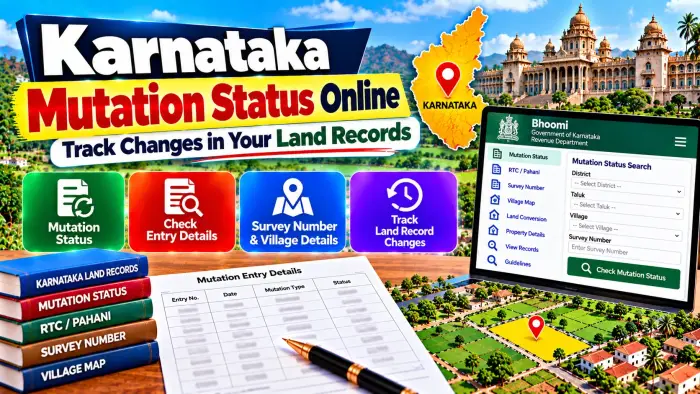
For agricultural land, Karnataka's digital land-record ecosystem includes Bhoomi, where RTC/Pahani and mutation-related information play important roles. Checking Karnataka Mutation Status Online can help landowners, buyers and legal heirs understand whether a requested change in the revenue record has been processed.
A mutation should not be confused with a registered sale deed. Registration records the applicable property transaction, while mutation deals with updating the corresponding revenue record. Similarly, an RTC and a mutation-register entry serve different purposes.
This guide explains Karnataka land mutation, how to track changes, what details you should keep ready, and how mutation relates to RTC, Survey Number and property ownership.
Karnataka Mutation Status – Quick Overview
| Details | Information |
|---|---|
| State | Karnataka |
| Process | Land Record Mutation |
| Land Record System | Bhoomi |
| Related Record | RTC / Pahani |
| Mutation Record | Mutation Register / MR |
| Main Property Identifier | Survey Number |
| Additional Identifier | Hissa Number |
| Location Details | District, Taluk, Hobli and Village |
| Common Reasons | Sale, inheritance, gift, partition |
| Main Purpose | Update applicable revenue records |
| Landholder Change | Subject to mutation process |
| Status | Can depend on verification and approval |
| Registered Deed | Separate from mutation record |
| RTC Update | Can reflect completed applicable changes |
| Ownership Verification | Check registered and revenue records together |
What Is Land Mutation in Karnataka?
Land mutation is the process through which an applicable change in rights or landholding is entered into the revenue records.
Suppose agricultural land is sold to another person. The registered transaction establishes the relevant transfer document, but the revenue records may also need to be updated to reflect the resulting change.
A similar requirement can arise when land passes through inheritance, gift or partition.
The mutation process therefore helps keep land records aligned with legally relevant changes affecting the property.
What Is Karnataka Mutation Status?
Mutation status indicates the progress or result of a mutation-related land-record change.
After an applicable request or transaction enters the land-record workflow, it may need verification and processing before the corresponding revenue information is updated.
Checking the status can help determine whether the change is still being processed or whether the applicable record has been updated.
The exact status labels can vary according to the current government system and workflow.
Therefore, users should read the status together with any remarks or related record information shown by the official service.
Why Is Mutation Important?
Mutation is important because land revenue records should accurately reflect applicable changes in rights and landholding.
An outdated record can create confusion when checking RTC/Pahani, applying for certain land-related services or verifying property details.
For example, a buyer may have a registered deed but still find the previous landholder's name in an older RTC.
In such a situation, the mutation history can help explain whether the revenue-record change has been processed.
Mutation records are also useful for understanding how the recorded rights associated with a property have changed over time.
Common Reasons for Land Mutation
A mutation can arise from different legally relevant events.
A sale is one common reason. When agricultural land is transferred through a registered sale, corresponding revenue records may need updating.
Inheritance is another common reason. When a recorded landholder dies, eligible heirs may need to have the land record updated according to the applicable process.
A gift or partition can also lead to changes in landholding information.
Court orders and certain other legally recognized events can also affect property records depending on the circumstances.
Details Required to Track Mutation
Before checking mutation-related information, collect the available land and application details.
Useful information can include:
District
Taluk
Hobli
Village
Survey Number
Hissa Number, where applicable
Mutation or MR reference
Landholder details
Registered document details
An older RTC, registered deed, mutation document or acknowledgment can help you identify these details.
Always verify the complete location because a Survey Number is meaningful within its specific village and survey jurisdiction.
How to Check Karnataka Mutation Status Online
Begin with Karnataka's applicable official land-record service.
Choose the Bhoomi or mutation-related service available for citizens.
Select the relevant District, Taluk, Hobli and Village where required.
Enter or select the Survey Number and applicable Hissa information.
If the service asks for a mutation or MR reference, enter the correct number.
Complete any verification required by the portal.
Submit the details and review the available mutation information or status.
The Karnataka Government may update its digital services, so exact menus, fields and status names can change. Follow the instructions currently displayed on the official government portal.
What Is a Mutation Register?
The Mutation Register, often referred to in connection with MR records, maintains information relating to changes in land rights or revenue entries.
It can help establish the record of how an applicable landholding changed.
For example, if an older RTC shows one landholder and a newer RTC shows another, the relevant mutation-register information can help explain the change.
The Karnataka Government treats a latest extract of the mutation register as a distinct land document from the latest RTC.
This distinction is important when performing detailed property verification.
Mutation Status and RTC/Pahani
Mutation and RTC are closely related, but they are not the same thing.
RTC/Pahani is the Record of Rights, Tenancy and Crops and contains applicable information relating to agricultural land.
A mutation record documents changes affecting the recorded rights.
After an applicable mutation has been processed, the resulting change can be reflected in the relevant revenue record.
Therefore, users should check both the mutation information and the latest RTC when verifying whether a land-record change has been reflected.
Mutation and Survey Number
The Survey Number identifies the relevant surveyed land parcel within a village.
When a mutation affects a particular parcel, the Survey Number helps connect the change with the correct land.
If the Survey Number has subdivisions, the Hissa Number can also be important.
Always compare the Survey/Hissa reference in the mutation information with the registered property document and RTC.
A mismatch may indicate that you are checking a different parcel or subdivision.
Mutation After Buying Agricultural Land
After buying agricultural land, keep the registered sale document safely and check the corresponding revenue records.
Verify the District, Taluk, Hobli and Village.
Compare the Survey Number and Hissa Number.
Check the land extent and relevant mutation information.
After the applicable process is completed, compare the latest RTC with the registered deed.
If the old landholder continues to appear, investigate whether the mutation is pending, disputed or whether another record issue exists.
Do not assume that every revenue-record update happens immediately after registration.
Mutation After Inheritance
Inheritance can also require changes in revenue records.
When the recorded landholder dies, the applicable legal heirs may need to establish their claim using the required supporting documents.
The exact documents and procedure can depend on the circumstances.
Where several heirs are involved, the revenue record may need to reflect the applicable rights of multiple persons.
If inheritance itself is disputed, the mutation process can become more complex and may require examination of additional legal documents or orders.
Mutation After Gift or Partition
A valid gift or partition can also affect landholding.
Where a property is transferred through a legally applicable gift document, corresponding revenue records may require updating.
Similarly, when jointly held land is partitioned, separate rights or portions may need to be reflected in the relevant records.
Survey and Hissa information becomes particularly important where the land has been divided into separate portions.
Users should compare the mutation information with the underlying registered or legally relevant documents.
Mutation Status Before Buying Land
Mutation history can provide useful information before purchasing agricultural land.
First, check the current RTC and identify the recorded landholder.
Then compare the Survey Number, Hissa Number and extent with the seller's registered documents.
Review relevant mutation information to understand important changes in the revenue record.
If a recent mutation is pending or the available records contain inconsistent names, investigate the reason before proceeding.
For a major property transaction, mutation should be only one part of a broader verification process.
Mutation vs Registered Sale Deed
A mutation record and a registered sale deed have different purposes.
The registered sale deed documents the applicable property transaction.
The mutation process updates applicable revenue records based on a qualifying change.
Therefore, mutation does not replace the registered deed.
Similarly, the existence of a registered deed does not mean that users should ignore the current revenue records.
For better verification, examine the registered document, latest RTC and relevant mutation-register entries together.
What If Mutation Status Is Pending?
A pending status generally means the applicable mutation process has not yet reached its final outcome.
There can be several reasons for this.
The application may still be under verification, documents may need examination, or an objection or another administrative issue may exist.
Check any remarks displayed by the official system.
Also make sure that the property and reference details were entered correctly.
If the matter remains unresolved, use the appropriate Revenue Department channel for clarification instead of relying on an unofficial intermediary.
What If Mutation Is Not Reflected in RTC?
First confirm that you are checking the latest applicable RTC.
Verify the Survey Number, Hissa Number and Village.
Then compare the mutation reference with the registered or inheritance documents.
If the mutation has not reached the applicable final stage, the expected change may not yet appear.
If the mutation appears completed but the current land record still contains inconsistent information, the matter may require clarification or correction through the competent Revenue authority.
Mutation and Encumbrance Certificate
A Mutation Register extract and an Encumbrance Certificate are different records.
The mutation record relates to changes in revenue entries.
An Encumbrance Certificate is associated with registered transactions or encumbrances recorded through the registration system for the applicable period and property.
For detailed land verification, one document should not automatically be treated as a replacement for the other.
Karnataka Government documentation may require RTC, mutation-register extracts, registered documents and Encumbrance Certificates separately for certain land-related processes.
Does Mutation Prove Legal Ownership?
Mutation is an important revenue-record process, but a mutation entry alone should not automatically be treated as conclusive proof of legal title.
Legal ownership can depend on registered sale deeds, inheritance documents, gift or partition deeds, court orders and other relevant documents.
Revenue records help show how rights are recorded for administrative purposes.
For complete title verification, examine the mutation history together with the latest RTC, registered documents and other relevant property records.
Frequently Asked Questions (FAQ)
1. What is Karnataka land mutation?
Land mutation is the process of updating applicable revenue records after a qualifying change in land rights or landholding.
2. Can Karnataka mutation status be checked online?
Applicable mutation-related information can be accessed through Karnataka's digital land-record services, subject to the current services available.
3. What is an MR number?
MR commonly refers to a Mutation Register reference associated with a land-record change.
4. Is mutation the same as RTC?
No. RTC/Pahani is a land revenue record, while mutation records changes affecting applicable rights.
5. What details are useful for tracking mutation?
District, Taluk, Hobli, Village, Survey Number, Hissa Number and mutation reference can be useful.
6. Can land mutation happen after a sale?
Yes. An applicable registered sale can result in a corresponding revenue-record mutation process.
7. Can mutation be required after inheritance?
Yes. Inheritance can require updating the applicable revenue records based on the relevant documents and verification.
8. What should I do if mutation is not reflected in RTC?
Check the latest RTC, mutation status and Survey/Hissa details. If the discrepancy remains, use the applicable Revenue Department process.
9. Is a Mutation Register the same as an Encumbrance Certificate?
No. They serve different purposes and may both be relevant during property verification.
10. Does mutation alone prove ownership?
No. Mutation is an important revenue record, but complete title verification can also require registered and other legally relevant documents.
Conclusion
Karnataka Mutation Status Online can help landowners, buyers and legal heirs understand changes being made to agricultural land records. Mutation becomes important when land rights change because of sale, inheritance, gift, partition or another qualifying event.
When tracking a mutation, verify the District, Taluk, Hobli, Village, Survey Number, Hissa Number and applicable MR reference. After the process is completed, compare the latest RTC/Pahani with the registered or other supporting property documents.
If the mutation remains pending or the expected change does not appear in the RTC, check the available status and use the appropriate Revenue Department procedure for clarification.
For reliable land verification, examine the latest RTC, Mutation Register, registered property documents, survey details and other applicable records together rather than relying on a single land-record entry.