Karnataka RTC Pahani Online – Check Landholder Name and Agricultural Land Details
Land records are important for farmers, landowners, buyers and legal heirs who want to verify agricultural land in Karnataka. One of the most commonly used land records in the state is the RTC, also widely known as Pahani.
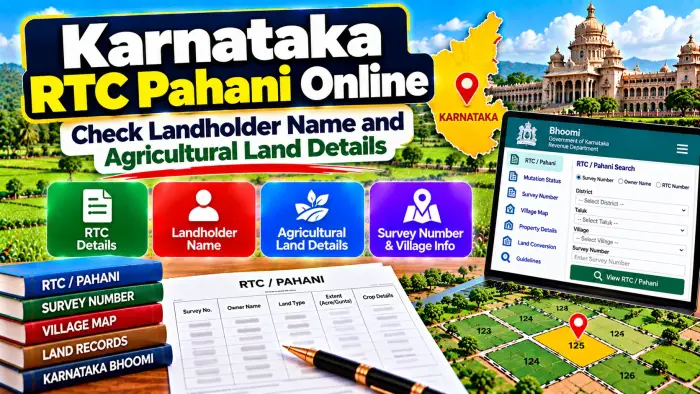
RTC stands for Record of Rights, Tenancy and Crops. It is an important revenue record associated with agricultural land and can provide information relating to the recorded landholder, survey details, extent and other land-related particulars.
Karnataka has digitized land records through the Bhoomi land-record system, making it easier for citizens to access applicable RTC information electronically. Survey Number and Hissa Number are particularly important when identifying a specific agricultural land parcel.
This guide explains Karnataka RTC Pahani Online, how to check landholder and agricultural land details, the difference between Survey Number and Hissa Number, and what to verify before relying on an RTC for a property transaction.
Karnataka RTC Pahani – Quick Overview
| Details | Information |
|---|---|
| State | Karnataka |
| Record Name | RTC / Pahani |
| Full Form | Record of Rights, Tenancy and Crops |
| Record Category | Agricultural Land Record |
| Land Record System | Bhoomi |
| Main Identifier | Survey Number |
| Additional Identifier | Hissa Number |
| Location Details | District, Taluk, Hobli and Village |
| Landholder Information | Available in applicable RTC |
| Land Extent | Recorded in land details |
| Agricultural Information | Available in applicable records |
| Mutation | Used to update applicable land rights |
| Survey Record | Survey/Hissa details |
| Official Record | Revenue Department |
| Legal Verification | Compare with registered documents |
What Is Karnataka RTC or Pahani?
RTC is an important agricultural land record maintained under Karnataka's Revenue administration.
The term Pahani is commonly used for the RTC record.
The document helps identify a particular landholding and provides revenue information associated with the land.
It can be useful for checking the recorded landholder and survey-related particulars before a transaction, inheritance process or other land-related activity.
Because RTC is a revenue record, it should be checked together with registered property documents and other applicable records when complete ownership verification is required.
What Information Can an RTC Contain?
An RTC can contain several important details relating to agricultural land.
Depending on the applicable record, users may find information relating to the landholder, Survey Number, Hissa or subdivision, extent and other land particulars.
Agricultural and crop-related information can also form part of the broader RTC/Pahani record system.
The information should be reviewed carefully because different sections of an RTC serve different purposes.
If you are checking a specific property, first confirm that the location, Survey Number and Hissa Number correspond with your registered documents.
What Is a Survey Number?
A Survey Number is one of the most important identifiers for agricultural land in Karnataka.
It identifies a surveyed land parcel within a particular village.
The same numerical Survey Number can exist in different villages, so the number alone is not sufficient for identifying a property.
Always check it together with the District, Taluk, Hobli and Village.
Survey Numbers are frequently used across RTC, mutation and survey-related records, making them an essential reference for land verification.
What Is a Hissa Number?
A larger Survey Number may be divided into smaller portions or subdivisions.
A Hissa Number helps identify the applicable portion of a Survey Number.
For example, two different landholders may have land associated with separate portions of an originally larger survey field.
This is why users should check the complete Survey and Hissa reference when it appears in the record.
Karnataka Government's Land Resource Information system also supports searches using Survey/Hissa information and displays owner and land-extent-related fields.
Details Required to Check Karnataka RTC Pahani
Before beginning a land-record search, collect the property information from your existing documents.
Important details can include:
District
Taluk
Hobli
Village
Survey Number
Hissa Number, where applicable
Landholder's name
Mutation details, where relevant
These details may be found in an older RTC, registered deed, mutation record or survey document.
Using accurate location information is particularly important because Survey Numbers are specific to their respective land-record jurisdiction.
How to Check Karnataka RTC Pahani Online
Start with the official Karnataka land-record service associated with Bhoomi.
Choose the applicable option for viewing RTC or land records.
Select the District where the agricultural land is located.
Next, choose the Taluk, Hobli and Village.
Enter or select the relevant Survey Number.
Where applicable, select the Hissa or subdivision information.
Provide any additional details requested by the current system.
Complete the verification and submit the search.
Review the available RTC information carefully.
Government portals can change their interface, so the exact sequence of fields or buttons may be updated over time.
How to Check Landholder Name in RTC
Once the correct RTC has been identified, review the landholder or rights-related section of the record.
Make sure the name corresponds with the property and documents you are checking.
Do not rely on a name alone to identify agricultural land.
People can have similar names, and the same person may hold multiple parcels.
Always match the name with the Survey Number, Hissa Number, Village and land extent.
If the name differs from the registered transaction document, check whether the applicable mutation has been completed.
How to Check Agricultural Land Details
RTC/Pahani is particularly relevant to agricultural land.
After locating the record, review the Survey and Hissa details and compare the extent with your documents.
Agricultural or crop-related information can also be relevant depending on the record and period.
Remember that cultivation details can change between agricultural seasons.
Therefore, an old RTC should not automatically be treated as proof of what crop is currently being grown on the land.
For agricultural planning, Karnataka also operates land-resource systems that provide survey-level soil, crop-suitability and agricultural information.
RTC and Mutation Records
Mutation is important when the recorded rights in land change.
For example, a mutation may become relevant after an applicable sale, inheritance, gift, partition or another qualifying event.
The mutation process updates the applicable revenue information following verification.
If you have purchased agricultural land but the RTC still shows an earlier landholder, check the applicable mutation status and supporting records.
A registered transaction and a revenue-record mutation are related but distinct processes.
RTC After Buying Agricultural Land
After purchasing agricultural land, compare the registered deed with the current revenue record.
Check the District, Taluk, Hobli and Village.
Then compare the Survey Number and Hissa Number.
Review the land extent.
Check whether the applicable mutation has resulted in the expected landholder information being reflected in the RTC.
If the current record does not match the registered document, investigate the reason instead of assuming that the online record will update automatically without the applicable administrative process.
RTC for Inherited Land
RTC can also be important when agricultural land passes through inheritance.
If the recorded landholder has died, applicable heirs may need to complete the prescribed revenue-record process.
Supporting inheritance or succession documents can be required depending on the case.
Where several heirs are involved, the landholding record may need to reflect their respective rights according to the applicable documents and Revenue procedure.
Inheritance disputes can require additional examination beyond a simple land-record update.
RTC vs Mutation Record
RTC and mutation records should not be treated as identical.
RTC/Pahani shows the applicable current revenue information relating to the agricultural land.
A mutation record helps document changes affecting the rights or landholding information.
When a current RTC differs from an older RTC, the mutation history can help explain how the record changed.
Checking both can therefore provide a clearer understanding of the property's revenue-record history.
RTC vs Registered Sale Deed
A registered sale deed and RTC have different purposes.
The sale deed documents the applicable registered property transaction.
The RTC is a Revenue Department land record.
A buyer should therefore check both.
The sale deed helps establish the basis of the transaction, while the updated RTC can show how the applicable landholding is reflected in the revenue system.
One should not automatically be treated as a replacement for the other.
How RTC Helps Before Buying Agricultural Land
RTC can be useful during preliminary verification before buying land.
First, compare the seller's name with the applicable revenue information.
Then verify the Survey Number and Hissa Number.
Compare the land extent.
Review relevant mutation information.
Also check whether the property description in the registered documents corresponds with the land you intend to purchase.
For a major transaction, additional title, registration, encumbrance and survey-related verification can also be necessary.
What If RTC Details Are Incorrect?
First confirm that you selected the correct District, Taluk, Hobli, Village, Survey Number and Hissa Number.
Compare the online record with the registered deed, previous RTC and mutation information.
A difference may result from a pending mutation, subdivision, inheritance issue, old entry or another record discrepancy.
Do not assume that every problem can be corrected simply by editing an online form.
The applicable Revenue or Survey authority may need to examine supporting documents before the record is changed.
RTC and Land Survey Details
RTC provides revenue information, while survey records focus more specifically on the identification and measurement of land parcels.
If a property has a boundary or measurement issue, RTC alone may not resolve it.
Survey Number and Hissa information can help identify the parcel, but exact physical demarcation may require the applicable official survey procedure.
This is particularly important where neighbouring owners disagree about boundaries or where physical possession differs from the available records.
Can RTC Be Used as Ownership Proof?
RTC is an important land revenue record and can be useful as supporting evidence relating to recorded landholding.
However, it should not automatically be treated as standalone conclusive proof of legal title.
Complete title verification can require registered sale deeds, inheritance documents, gift or partition deeds, court orders and other relevant records.
Mutation history and survey records can also be important.
For a significant land transaction, examine the complete set of applicable documents.
Safety Tips While Checking RTC Online
Use Karnataka Government's official land-record services.
Check the complete location, Survey Number and Hissa Number before relying on a result.
Avoid unknown websites or agents promising guaranteed changes to RTC records.
Never share banking passwords, ATM PINs, UPI PINs or other sensitive financial credentials merely to view a land record.
For corrections, mutation or official survey requirements, use the applicable government procedure.
Frequently Asked Questions (FAQ)
1. What is Karnataka RTC?
RTC stands for Record of Rights, Tenancy and Crops and is an important agricultural land record in Karnataka.
2. Is RTC also called Pahani?
Yes. Pahani is commonly used to refer to the RTC land record.
3. Can I check Karnataka RTC online?
Karnataka provides computerized land-record services through the Bhoomi system for applicable RTC information.
4. What details are needed to check RTC?
District, Taluk, Hobli, Village and Survey Number are important. Hissa Number can also be required for subdivided parcels.
5. Can RTC show the landholder's name?
Applicable RTC records contain rights or landholder-related information associated with the land parcel.
6. What is a Hissa Number?
A Hissa Number identifies an applicable subdivision or portion within a Survey Number.
7. Can RTC contain agricultural information?
RTC/Pahani is associated with agricultural land and can contain crop and other land-related information depending on the record.
8. What should I do if an old owner's name appears in RTC?
Check whether the applicable mutation has been completed and compare the RTC with the registered transaction and mutation records.
9. Is RTC the same as a registered sale deed?
No. A sale deed records the property transaction, while RTC is a Revenue Department land record.
10. Does RTC alone prove legal ownership?
RTC is an important revenue record, but complete title verification can require registered deeds and other relevant legal documents.
Conclusion
Karnataka RTC Pahani Online makes it easier to check important agricultural land information using the state's computerized land-record system. By selecting the correct District, Taluk, Hobli and Village and using the appropriate Survey Number and Hissa Number, users can identify the relevant land record and review applicable landholder and agricultural details.
When checking an RTC, compare the landholder name, Survey/Hissa reference and land extent with your registered property documents. If the information has changed because of sale, inheritance or another event, review the applicable mutation records as well.
Most importantly, do not rely on RTC alone for complete title verification. RTC, mutation history, survey information and registered legal documents should be examined together when making an important decision about agricultural land.