Odisha Bhulekh Land Records – Understand RoR, Khatiyan and Plot Information
Land records are important for landowners, farmers, property buyers and legal heirs who want to understand the recorded details of a property. In Odisha, citizens can access important land information online through Bhulekh Odisha, the state's digital land-record portal.
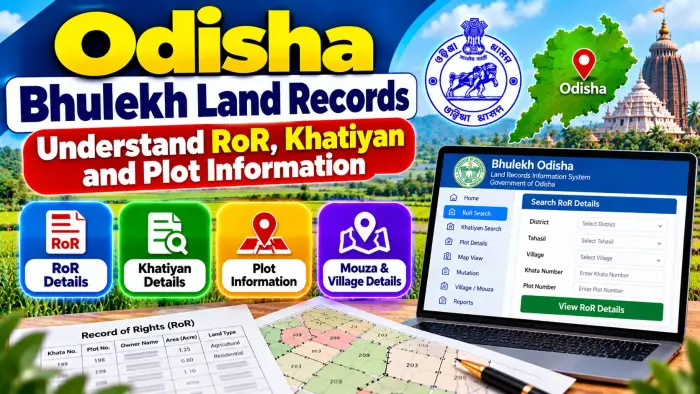
Bhulekh provides access to Record of Rights (RoR), Khatiyan, Plot and Tenant information. Users can select the District, Tahasil and Village and then search for the relevant land record using a Khatiyan Number, Plot Number or Tenant details.
Understanding the difference between RoR, Khatiyan and Plot information is important. These terms are related, but they do not represent exactly the same thing. A Khatiyan relates to the landholding record, while a Plot Number identifies an individual parcel. RoR brings together important revenue information connected with the holding.
This guide explains Odisha Bhulekh Land Records, how to search them online and what information you should verify before relying on a land record.
Odisha Bhulekh Land Records – Quick Overview
| Details | Information |
|---|---|
| State | Odisha |
| Land Record System | Bhulekh Odisha |
| Main Record | Record of Rights (RoR) |
| Landholding Reference | Khatiyan / Khata |
| Parcel Reference | Plot Number |
| Search by Khatiyan | Available |
| Search by Plot | Available |
| Search by Tenant | Available |
| Location Required | District, Tahasil and Village |
| Tenant Details | RoR Front Page |
| Rent & Cess Details | RoR Front Page |
| Plot Details | RoR Back Page |
| Village/Plot Map | Map View |
| Plot Unique ID | Available |
| Language | English and Odia |
| Record Issues | Concerned Tahasil / Land Records Authority |
What Is Bhulekh Odisha?
Bhulekh Odisha is the online land-record portal of Odisha's Revenue and Disaster Management Department.
It provides citizens with digital access to Khata, Plot and Tenant details for land parcels in the state.
Instead of relying only on physical record searches, users can select the location of their property and access available land information online.
Bhulekh is particularly useful for checking basic revenue information, identifying plots connected with a landholding and comparing online records with existing property documents.
What Is Record of Rights or RoR?
RoR stands for Record of Rights.
It is an important revenue record containing information associated with a particular landholding.
RoR can include the recorded tenant or landholder and information relating to the land connected with the record.
The Odisha Bhulekh system presents useful information across the RoR pages.
The Front Page can provide applicable Tenant, Rent and Cess information, while the Back Page can be used to check the plots associated with the record.
Therefore, users should examine the complete available RoR when researching a property.
What Is a Khatiyan?
A Khatiyan is an important reference associated with a landholding in Odisha's revenue-record system.
The Khatiyan Number can be used to locate the relevant RoR after selecting the correct District, Tahasil and Village.
A Khatiyan may contain one or multiple plots depending on the landholding.
For example, if a person has several parcels recorded under the same holding, those parcels may appear as separate Plot Numbers connected with the Khatiyan.
This is why Khatiyan Number and Plot Number should not be treated as identical.
What Is a Plot Number?
A Plot Number identifies an individual land parcel within the relevant revenue village.
It helps distinguish one parcel from another.
Plot Numbers are commonly found in RoR and other property-related documents.
When checking a Plot Number, always confirm the District, Tahasil and Village.
The same numerical Plot Number can potentially exist in different villages, so a number by itself should not be used to identify a property.
RoR vs Khatiyan vs Plot Number
RoR, Khatiyan and Plot Number are connected but serve different purposes.
The RoR is the revenue record containing applicable information about the landholding and recorded rights.
The Khatiyan Number is associated with the particular landholding record.
The Plot Number identifies an individual parcel.
A single Khatiyan can contain multiple plots. Therefore, when checking one specific piece of land, identify the correct Plot Number within the relevant Khatiyan.
Understanding these differences makes it easier to interpret Bhulekh records correctly.
How to Check Odisha Bhulekh Land Records Online
Start with the official Bhulekh Odisha portal.
Open the RoR viewing service.
Select the District where the property is located.
Choose the appropriate Tahasil.
Select the correct Village.
The portal then allows you to choose the search method.
Select Khatiyan if you know the Khatiyan Number.
Choose Plot if you know the Plot Number.
Alternatively, choose Tenant if you want to locate the record through tenant information.
Open the relevant RoR and carefully review the available details.
How to Search by Khatiyan Number
If you know the Khatiyan Number, select the District, Tahasil and Village first.
Choose the Khatiyan search option and select the relevant number.
Open the corresponding RoR.
Check the recorded tenant information on the applicable Front Page.
Then review the RoR Back Page to see all plots associated with the landholding.
If several plots appear, identify the exact Plot Number corresponding with the property you want to verify.
How to Search by Plot Number
If you know the Plot Number but do not know the Khatiyan, Bhulekh provides a Plot-based search.
Select the District, Tahasil and Village.
Choose the Plot option and select the relevant Plot Number.
Open the corresponding land record.
You can then check the Khatiyan and tenant information associated with that parcel.
Plot search is particularly useful when you already have the parcel number from a registered document or an older land record.
How to Search by Tenant Details
Bhulekh also provides a Tenant search option.
After selecting the District, Tahasil and Village, choose the Tenant option.
Locate the relevant record and open the RoR.
Searching by tenant can be useful when you know the recorded person's information but do not have the Khatiyan or Plot Number.
However, a person's name alone should not be used to confirm a property.
Always compare the name with the corresponding Khatiyan, Plot Number and location.
Understanding the RoR Front Page
The RoR Front Page contains important information relating to the landholding.
Bhulekh provides applicable tenant information along with rent and cess details on this page.
When checking the recorded tenant, compare the information with your existing property documents.
If a previous landholder continues to appear after a recent sale or inheritance, the mutation or land-record update history may need to be checked.
An older recorded name does not automatically explain the current legal status of the property.
Understanding the RoR Back Page
The RoR Back Page is important for checking the plots connected with a landholding.
Bhulekh allows users to view all applicable plot details through this section.
Review every Plot Number carefully.
If a Khatiyan contains several plots, identify which parcel corresponds with the land you are researching.
This is particularly important when only one parcel from a larger landholding is being purchased, inherited, gifted or transferred.
How to Check Odisha Land Maps
Bhulekh also provides a Map View facility.
Users can select details such as District, Tahasil, Village, RI Circle and Plot Number to locate an applicable plot map.
Village Maps are also available through the Map View section.
The digital map can help users understand where a plot is located in relation to surrounding parcels.
However, an online cadastral map should not automatically be treated as an official physical boundary demarcation when the exact boundary is disputed.
What Is Plot Unique ID?
Bhulekh provides a facility to search land using a Plot Unique ID.
Users who do not know the unique reference can identify it using District, Tahasil, Village, Khatiyan and Plot information.
The unique identifier can help distinguish a specific parcel within the digital land-record system.
Even when using a Plot Unique ID, verify the associated Khatiyan, Plot Number and location against your property documents.
Bhulekh Records and Mutation
Land records may require updating when rights in a property change.
This process is generally associated with mutation.
Mutation can become relevant after a sale, inheritance, gift, partition or another qualifying event.
A registered property deed and mutation serve different purposes.
The registered document records the applicable transaction, while mutation updates the corresponding revenue record.
Therefore, after a property transaction, check whether the expected changes are reflected in the current RoR.
What If an Old Landholder Name Appears?
An older landholder's name can sometimes remain in a revenue record if the applicable update has not been completed.
First verify that you have selected the correct property.
Check the District, Tahasil, Village, Khatiyan and Plot Number.
Compare the online RoR with the registered deed, mutation records and inheritance documents where applicable.
If the record genuinely requires updating, contact the concerned Tahasil and follow the appropriate official process.
What If Bhulekh Information Is Incorrect?
Do not immediately assume that an online mismatch means the property itself is invalid.
First check whether you selected the correct location and record.
Compare the online information with previous RoR documents, registered deeds, mutation records and applicable survey documents.
If a genuine discrepancy remains, contact the concerned Tahasil or land-record authority.
Use official correction or mutation procedures rather than relying on unauthorized agents who promise immediate changes.
Bhulekh Before Buying Land
Bhulekh can be useful for preliminary land verification before purchasing property.
Start with the seller's registered property documents.
Identify the correct District, Tahasil, Village, Khatiyan and Plot Number.
Search the corresponding RoR.
Check the recorded tenant details.
Review all relevant plots and use Map View where parcel identification is useful.
For important transactions, also examine applicable mutation, inheritance, registration, encumbrance and survey-related records.
Does Bhulekh RoR Prove Legal Ownership?
Bhulekh provides important revenue information, but an online RoR entry should not automatically be treated as the only conclusive proof of legal title.
Property rights can also depend on registered sale deeds, inheritance documents, gift or partition deeds, court orders and other legally relevant records.
Mutation and survey information can provide additional context.
Therefore, complete property verification should involve the relevant revenue and registered documents rather than relying on one online entry.
Frequently Asked Questions (FAQ)
1. What is Bhulekh Odisha?
Bhulekh is Odisha's online land-record portal for checking applicable RoR, Khatiyan, Plot and Tenant information.
2. What is RoR?
RoR means Record of Rights, an important revenue record containing information associated with a landholding.
3. What is a Khatiyan Number?
A Khatiyan Number is an important reference associated with a particular landholding record.
4. What is a Plot Number?
A Plot Number identifies an individual land parcel within the relevant revenue village.
5. Is Khatiyan Number the same as Plot Number?
No. Khatiyan relates to the landholding record, while Plot Number identifies a particular parcel.
6. Can one Khatiyan contain multiple plots?
Yes. A Khatiyan can contain multiple applicable Plot Numbers.
7. Can I search Odisha land records by tenant name?
Yes. Bhulekh provides a Tenant search option after selecting the correct District, Tahasil and Village.
8. Can I check all plots online?
Yes. Applicable plot details can be viewed on the RoR Back Page.
9. Can I view Odisha land maps online?
Yes. Bhulekh provides Map View and applicable Village Map facilities.
10. What should I do if Bhulekh information is incorrect?
Verify the property details and supporting documents first. If a genuine discrepancy remains, contact the concerned Tahasil or appropriate land-record authority.
Conclusion
Odisha Bhulekh Land Records provide a convenient way to understand important property information through RoR, Khatiyan and Plot details.
Start by selecting the correct District, Tahasil and Village. You can then search the land record using Khatiyan, Plot or Tenant information. Check the RoR Front Page for applicable tenant, rent and cess information and the Back Page for associated plots.
Bhulekh also provides Map View and Plot Unique ID facilities to help users identify specific parcels.
For important property matters, compare the Bhulekh record with registered deeds, mutation history, inheritance documents and relevant survey records. Understanding how RoR, Khatiyan and Plot information work together can help you interpret Odisha land records more accurately.