Tamil Nadu Patta Chitta Online – How to Check Land Ownership and Survey Details
Checking land records is an important step for property owners, buyers, farmers and legal heirs in Tamil Nadu. Among the most commonly used terms in the state's land-record system are Patta and Chitta. These records help users understand important revenue information associated with a particular parcel of land.
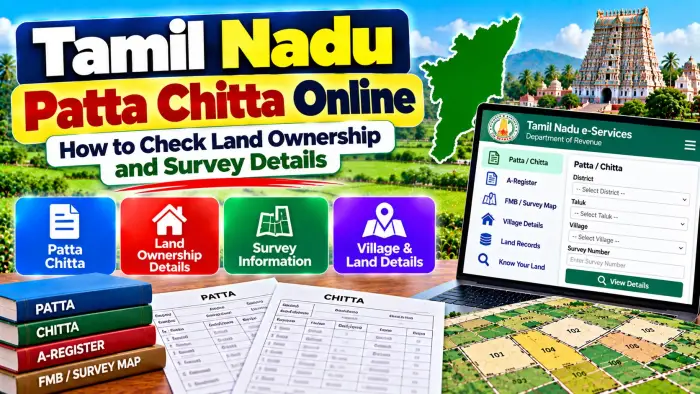
Tamil Nadu has digitized several land-record services, making it possible to access available Patta/Chitta, survey and related information online. Users can search land details using information such as district, taluk, village, Patta number, survey number and subdivision number, depending on the service.
A Tamil Nadu Patta Chitta Online search can be useful for preliminary verification of recorded landholder and survey information. However, revenue records should be compared with registered deeds and other relevant documents before making an important property decision.
Tamil Nadu Patta Chitta – Quick Overview
| Details | Information |
|---|---|
| State | Tamil Nadu |
| Main Land Record | Patta / Chitta |
| Department | Revenue & Disaster Management / Survey and Land Records |
| Main Property Identifier | Survey Number |
| Additional Identifier | Subdivision Number |
| Patta Number | Important land-record reference |
| Location Details | District, Taluk and Village |
| Owner Details | Available in applicable records |
| Land Type | May be recorded |
| Land Extent | May be available |
| A-Register | Related land record |
| FMS | Field Measurement Sketch |
| TSLR | Town Survey Land Register |
| Patta Transfer | e-Sevai service available |
| Ownership Verification | Compare with registered documents |
What Is Patta in Tamil Nadu?
Patta is an important revenue record associated with landholding in Tamil Nadu.
It can help identify the person or persons recorded in relation to a particular landholding and connect the holding with survey and other revenue information.
Depending on the applicable record, Patta-related information can be connected with details such as the Patta number, owner information, survey number, subdivision and land extent.
Because Patta is an important revenue record, property owners commonly check it after purchasing, inheriting or otherwise acquiring applicable rights in land.
However, Patta should not be treated as a substitute for the registered document through which legal rights may have been acquired.
What Is Chitta?
Chitta is another familiar term in Tamil Nadu land administration.
Historically, Chitta was used for revenue information relating to land, including ownership and classification details.
Tamil Nadu's computerized land-record system provides Patta/Chitta-related information digitally, and government services continue to use the terms Patta and Chitta in various administrative contexts.
For users, the important point is to check the current computerized land information against the correct survey number, subdivision, Patta and location.
What Information Can Patta Chitta Show?
The exact information depends on the applicable record and property.
Patta/Chitta-related land information can help users review details such as the recorded owner, Patta number, survey number, subdivision, land extent and applicable classification.
These details can be particularly useful when comparing an online revenue record with an existing sale deed or another property document.
Users should check all available identifiers rather than relying only on the owner's name because similar names can appear in land records.
What Details Are Needed to Check Patta Chitta?
Before starting a land-record search, collect the information available in your existing property documents.
Useful details can include:
District
Taluk
Village
Patta Number
Survey Number
Subdivision Number
Recorded owner details
These details may be found in a registered sale deed, previous Patta/Chitta extract, A-Register record, FMS or another property document.
Selecting the correct village is particularly important because similar survey numbers can exist in different locations.
How to Check Tamil Nadu Patta Chitta Online
Start with the official Tamil Nadu land-record e-service.
Choose the appropriate Patta/Chitta or land-record option currently provided.
Select the correct district, taluk and village.
Enter the Patta number or survey details requested by the service.
Where a survey number has multiple subdivisions, make sure the correct subdivision is selected.
Complete any authentication or verification requested by the system.
Submit the search and review the available land information.
The exact interface can change as government digital services are updated, so users should follow the current instructions displayed on the official system.
How to Search Using Patta Number
If you already know the Patta number, it can be a useful way to retrieve the applicable landholding information.
Select the district, taluk and village before entering the Patta number.
Official Tamil Nadu systems use location and Patta information to fetch applicable details from the land-record database.
Once the record is displayed, compare the owner information and survey details with your existing property documents.
A Patta number without the correct location should not be used to identify a property.
How to Check Land Using Survey Number
A survey number identifies a particular land parcel or survey unit within the relevant village records.
If you do not have the Patta number but know the survey number, use the applicable survey-based search where available.
Select the correct district, taluk and village and then enter the survey number.
If the parcel has subdivisions, check the complete subdivision reference.
This is important because different subdivisions of the same original survey number may represent separate portions of land.
What Is a Subdivision Number?
A large survey parcel can be divided into smaller portions.
When this happens, additional subdivision references may be used to identify individual portions.
For example, two properties may share the same main survey number but have different subdivision references.
Therefore, when comparing Patta/Chitta with a registered deed, check both the survey number and subdivision.
Using only the main survey number can lead to confusion about which portion of land is actually being examined.
What Is an A-Register?
The A-Register is another important Tamil Nadu land record.
It can contain survey-related information such as survey and subdivision details, land type, extent and other revenue particulars.
Tamil Nadu's land-record digitization has included services for viewing A-Register extracts.
When checking a property, comparing Patta/Chitta information with the applicable A-Register can provide additional information about the survey parcel.
The two records should be read according to their respective purposes.
What Is FMS?
FMS stands for Field Measurement Sketch.
It is a survey-related record that provides spatial or measurement information for land parcels.
Tamil Nadu's Survey and Land Records e-services include FMS-related access.
FMS can be useful when users need to understand the recorded layout or measurement of a survey parcel.
However, a digital FMS or map should not automatically be treated as an official physical boundary demarcation when a dispute exists on the ground.
An appropriate survey may be necessary in such situations.
What Is TSLR?
TSLR stands for Town Survey Land Register.
It is particularly relevant to applicable urban or town-survey areas.
Tamil Nadu's land-record e-services include TSLR along with Patta, Chitta and FMS.
Users dealing with property in urban areas may therefore encounter TSLR rather than relying solely on rural land-record terminology.
Always identify which type of record applies to the location of the property before beginning verification.
Patta Chitta vs Registered Sale Deed
Patta/Chitta and a registered sale deed serve different purposes.
A registered sale deed documents a property transaction through the registration system.
Patta/Chitta is part of the revenue land-record system.
Therefore, a Patta entry should not be treated as a replacement for the registered deed.
Similarly, completing a registered sale transaction does not necessarily mean that the revenue record has automatically been updated in every case.
The applicable Patta transfer process may need to be completed.
What Is Patta Transfer?
Patta transfer is used to update applicable revenue records following qualifying changes in landholding.
Tamil Nadu's e-governance system lists Patta Transfer among its Revenue services.
After purchasing or inheriting applicable land, the concerned person may need to use the prescribed process to have the relevant revenue record updated.
The documents and verification required depend on the type of transfer and the circumstances of the property.
Submission of an application does not by itself guarantee approval.
Check Patta Chitta Before Buying Land
Checking Patta/Chitta can be an important part of preliminary property verification.
Compare the seller's recorded information with the registered deed.
Check the district, taluk, village, Patta number, survey number, subdivision and land extent.
Also review other relevant documents, which may include prior title deeds, encumbrance information, A-Register details, FMS and applicable tax or revenue records.
If there are inconsistencies, understand them before completing the transaction.
What If Patta Chitta Details Are Incorrect?
If the owner name, survey number, subdivision or land extent appears incorrect, first compare the record with your registered deed and other official documents.
Determine whether the issue is caused by an old record, subdivision, transfer, clerical error or another change.
An official correction or Patta-related process may require supporting documents and verification by the appropriate Revenue authority.
Do not rely on unknown websites or agents claiming that they can instantly alter official land records.
Does Patta Chitta Prove Legal Ownership?
Patta/Chitta is important revenue-record information, but complete legal title verification should not rely on a single revenue record.
Legal rights in property may depend on registered sale deeds, gift deeds, partition documents, inheritance records, court orders and other relevant documents.
For a major property purchase or ownership dispute, a complete title examination may therefore be appropriate.
Patta/Chitta should be considered one important component of that broader verification.
Frequently Asked Questions (FAQ)
1. What is Tamil Nadu Patta Chitta?
Patta/Chitta refers to important Tamil Nadu revenue land-record information connected with landholding, survey and other property details.
2. Can I check Patta Chitta online?
Tamil Nadu provides digital land-record e-services for applicable Patta/Chitta and related records.
3. What details are needed to check Patta Chitta?
District, taluk, village, Patta number or survey details may be required depending on the service.
4. What is a Patta number?
It is an important reference associated with the applicable landholding in Tamil Nadu's revenue records.
5. What is a survey number?
A survey number identifies a land parcel or survey unit within the applicable village record.
6. What is a subdivision number?
It identifies a specific portion of a survey parcel after applicable subdivision.
7. What is an A-Register?
It is a land record containing applicable survey, subdivision, land type, extent and other revenue details.
8. What is FMS?
FMS means Field Measurement Sketch and provides survey-related spatial or measurement information.
9. Can I apply for Patta Transfer?
Tamil Nadu's e-governance system provides Patta Transfer as a Revenue service, subject to applicable eligibility and verification.
10. Does Patta Chitta alone prove property ownership?
It is an important revenue record, but complete title verification may require registered deeds and other legally relevant documents.
Conclusion
Tamil Nadu Patta Chitta Online makes it easier for property owners, buyers and other users to check available land ownership and survey-related revenue information digitally.
Using the correct district, taluk, village, Patta number, survey number and subdivision can help users identify the relevant record. Other records such as the A-Register, FMS and TSLR may provide additional information depending on the property and location.
For buying, selling, inheriting or resolving disputes involving land, do not depend solely on an online Patta/Chitta result. Compare it with the registered deed, applicable survey records, encumbrance information and other relevant documents. This provides a more complete understanding of both the revenue record and the property's legal documentation.