Telangana Pahani Land Records – How to Check Agricultural Land and Cultivation Details
Land records are important for farmers, landowners, buyers and legal heirs who want to understand agricultural property details in Telangana. Among the traditional and widely recognized agricultural land records in the state, Pahani is particularly important.
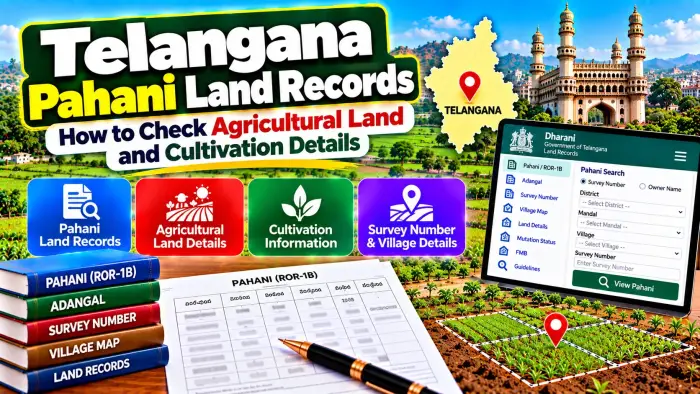
A Pahani is a village-level revenue record associated with agricultural land. It can provide useful information relating to a land parcel, recorded rights, cultivation and other revenue particulars. Telangana's land-record system has become increasingly digital, allowing citizens to search applicable land details using identifiers such as the Survey Number, Sub-Division Number and Pattadar Passbook Number.
The state's current integrated land-record platform is Bhu Bharati, which provides land-information and related revenue services.
This guide explains Telangana Pahani Land Records, how to check agricultural land details, the importance of Survey Numbers, how cultivation information should be understood, and what other documents should be reviewed during land verification.
Telangana Pahani Land Records – Quick Overview
| Details | Information |
|---|---|
| State | Telangana |
| Record Name | Pahani |
| Record Category | Agricultural / Revenue Land Record |
| Current Land Record Platform | Bhu Bharati |
| Main Property Identifier | Survey Number |
| Additional Identifier | Sub-Division Number |
| Landholder Reference | Pattadar details |
| Passbook | Pattadar Passbook |
| Agricultural Information | Available in applicable records |
| Cultivation Details | Recorded as applicable |
| Land Extent | Important parcel information |
| Related Record | Record of Rights / ROR |
| Mutation | Updates applicable land rights |
| Survey Information | Available through applicable services |
| Verification | Compare revenue and registered documents |
What Is Telangana Pahani?
Pahani is an important revenue record traditionally maintained for agricultural land in Telangana.
It is used to record information connected with agricultural parcels and their revenue administration.
Pahani records have also historically been used as a source of cultivation-related information. Telangana government descriptions of Tahsildar functions refer to crop-field inspections and field inspection details being entered in Pahani.
Because agricultural information can change from one season or year to another, users should always consider the period to which a particular Pahani relates.
An old Pahani can be useful for historical verification but may not describe the current cultivation situation.
What Information Can a Pahani Contain?
The exact contents can depend on the record and period.
Pahani is associated with agricultural land and can contain information connected with the land parcel, Survey Number, recorded landholder or rights, extent, land classification and cultivation.
Crop-related or field-inspection information can also form part of Pahani records.
The document can therefore be useful when researching both the revenue history and agricultural use of a parcel.
However, users should not assume that every piece of information appearing in an older Pahani remains current.
What Is a Survey Number?
A Survey Number is one of the most important identifiers for agricultural land.
It identifies a surveyed parcel within a specific village.
A numerical Survey Number alone is not enough to identify land across Telangana because similar numbers may exist in different villages.
You should therefore verify the District, Mandal and Village along with the Survey Number.
Telangana's current land-record search allows applicable records to be searched using a Survey Number or Sub-Division Number.
What Is a Sub-Division Number?
A larger Survey Number can sometimes be divided into separate portions.
A Sub-Division Number helps identify the particular portion involved.
This becomes important when only part of a larger parcel has been sold, inherited, partitioned or otherwise separated.
When a Sub-Division Number appears in your documents, compare the complete Survey and Sub-Division reference.
Do not assume that information relating to one subdivision automatically applies to the entire original Survey Number.
What Is a Pattadar?
The term Pattadar generally refers to the person whose applicable rights are recorded in relation to the land.
Pattadar information is important when checking agricultural land records.
Telangana's land-record system also uses the Pattadar Passbook, or PPB, as an important reference.
The current Bhu Bharati land-details search supports searching through Survey/Sub-Division details as well as Pattadar Passbook information.
When verifying property, compare Pattadar information with the Survey Number, extent and relevant registered documents.
How to Check Telangana Pahani Land Records Online
Begin with Telangana's official Bhu Bharati land-record system.
Open the applicable land-details or Pahani service.
Choose the available search method.
Where applicable, search using the Survey Number and Sub-Division Number.
Select the correct location details requested by the system.
Alternatively, applicable land information may be searched using Pattadar Passbook details.
Enter the requested information carefully.
Complete the verification required by the portal and submit the search.
Review the displayed land information and compare it with your existing records.
Because government portals can change, follow the current options and instructions displayed on the official system.
Details to Keep Ready Before Searching
Collect your land information before beginning the search.
Useful details include:
District
Mandal
Village
Survey Number
Sub-Division Number, where applicable
Pattadar name
Pattadar Passbook Number, where available
Land extent
Previous land documents
Keeping an older Pahani, registered deed or Pattadar Passbook nearby can make it easier to identify the correct parcel.
Always verify the complete location before relying on a search result.
How to Check Agricultural Land Details
After finding the correct land record, start by checking the Survey and Sub-Division Numbers.
Then review the recorded extent and Pattadar or rights-related information.
Compare these details with the property documents in your possession.
If the land has been subdivided, make sure you are checking the correct portion.
The Bhu Bharati system also provides survey-map related services in which citizens can view applicable survey details, boundaries, extent and geo-referenced parcel information.
Survey information can therefore provide additional context when identifying a parcel.
How to Understand Cultivation Details
Pahani has historically been important for agricultural and cultivation-related records.
Government descriptions of revenue administration in Telangana refer to crop-field inspection and field details being recorded in Pahani.
However, cultivation is not necessarily permanent.
The crop grown on agricultural land can change from season to season or year to year.
Therefore, if a Pahani shows a particular crop, understand that information in relation to the relevant record period.
An old crop entry should not automatically be described as the crop currently growing on the land.
Pahani and Record of Rights
Pahani and the broader Record of Rights (ROR) framework are related to land administration but should not be casually treated as identical documents in every context.
ROR focuses on recorded rights in land.
Pahani has traditionally contained agricultural and revenue information associated with the parcel.
Telangana's current Bhu Bharati citizen services also provide access to applicable ROR information and ownership-history services.
Checking multiple relevant records can provide a clearer picture than relying on a single entry.
Pahani and Pattadar Passbook
A Pattadar Passbook and Pahani serve related but different purposes.
The Pattadar Passbook is connected with the recorded landholding of the Pattadar.
Pahani provides parcel-level revenue and agricultural information.
When verifying agricultural land, compare the PPB details with the Survey Number, Sub-Division Number, extent and available land records.
Any significant mismatch should be investigated through the appropriate Revenue authority.
Pahani and Mutation
Land records may need to change when rights in agricultural land change.
This process is commonly associated with mutation.
A mutation can become relevant after an applicable sale, inheritance, gift, partition or another legally recognized event.
For example, Telangana government material explains that where a sale deed exists but mutation has not taken place, the purchaser may need to approach the Revenue authorities to have the purchaser's rights entered in the revenue records.
Therefore, a registered transaction and mutation should be understood as related but distinct processes.
Mutation After Buying Agricultural Land
After purchasing agricultural land, compare the registered document with the current revenue information.
Verify the Survey Number and Sub-Division Number.
Check the land extent.
Review the current recorded Pattadar information.
If the seller or previous landholder continues to appear where a change was expected, investigate the applicable mutation status.
Do not assume that holding a sale deed automatically means every revenue entry being viewed has already been updated.
Pahani for Inherited Land
Pahani can also be relevant when checking land that has passed through inheritance.
If the previous recorded holder has died, applicable succession and mutation procedures may be required to update the revenue records.
Where several legal heirs are involved, the situation can require examination of supporting inheritance documents.
The current revenue record should therefore be compared with the documents establishing the inheritance.
If there is a dispute among heirs, additional legal or revenue proceedings may be necessary.
Pahani Before Buying Agricultural Land
Checking Pahani and current land information can be an important part of preliminary property verification.
First, verify the seller's property documents.
Check the District, Mandal and Village.
Match the Survey and Sub-Division Numbers.
Compare the land extent and current recorded rights.
Review relevant mutation or ownership-history information.
Where exact boundaries are important, check applicable survey records.
For a major transaction, registration and encumbrance-related documents should also be examined.
What If Pahani Details Are Incorrect?
First confirm that you have searched the correct Village and Survey Number.
Check the Sub-Division Number carefully.
Compare the record with your Pattadar Passbook, registered deed and other available land records.
If there is an ownership, extent or survey-related discrepancy, Telangana's current land-record system provides applicable revenue-service mechanisms for corrections and grievances.
Do not rely on an unauthorized person promising an instant change to government land records.
Official verification and supporting documents may be required.
Does Pahani Prove Legal Ownership?
Pahani is an important revenue and agricultural land record, but it should not automatically be treated as standalone conclusive proof of legal title.
Ownership can depend on registered sale deeds, inheritance documents, gift or partition documents, court orders and other legally relevant records.
Mutation and ROR information can also be important.
For complete verification, examine the relevant revenue records together with registered and other title-related documents.
Frequently Asked Questions (FAQ)
1. What is Telangana Pahani?
Pahani is an important revenue record associated with agricultural land, including applicable parcel and cultivation-related information.
2. Can I check Telangana land records online?
Yes. Telangana's Bhu Bharati system provides online land-record and related information services.
3. Can land be searched by Survey Number?
Yes. The current Bhu Bharati land-details search supports Survey Number/Sub-Division Number based searches.
4. What is a Sub-Division Number?
It identifies an applicable portion created within a larger Survey Number.
5. Can Pahani contain crop information?
Pahani has traditionally included agricultural and field-related information, including applicable cultivation details.
6. Are old crop details always current?
No. Cultivation can change between seasons and years, so crop information should be understood in relation to the record period.
7. What is a Pattadar Passbook?
It is a landholding-related record associated with the recorded Pattadar and can also be used in applicable Bhu Bharati searches.
8. Is Pahani the same as a registered sale deed?
No. Pahani is a revenue record, while a registered deed documents an applicable property transaction.
9. What should I do if the landholder information is outdated?
Check the relevant mutation and current land-record information and use the applicable Revenue Department process where an update is required.
10. Does Pahani alone prove ownership?
No. Complete title verification can also require registered deeds and other relevant legal, revenue and survey records.
Conclusion
Telangana Pahani Land Records are useful for understanding important information connected with agricultural land, including parcel identification, recorded rights and applicable cultivation details.
The current Bhu Bharati system makes it possible to search applicable land information using important references such as the Survey Number, Sub-Division Number and Pattadar Passbook Number.
When checking a property, carefully compare the Village, Survey Number, subdivision, extent and Pattadar information with your existing documents. Remember that cultivation details can change over time, so an old Pahani should be interpreted according to its record period.
For complete agricultural land verification, examine Pahani and current ROR information together with mutation history, survey records and registered property documents rather than relying on a single online entry.