UP Khasra Number Search – Check Agricultural Plot and Land Area Details
Land records are important for farmers, landowners, property buyers and legal heirs who need to identify a specific parcel of land in Uttar Pradesh. One of the most important references used for individual agricultural plots is the Khasra Number, also commonly associated with the Gata Number in UP's digital land-record system.
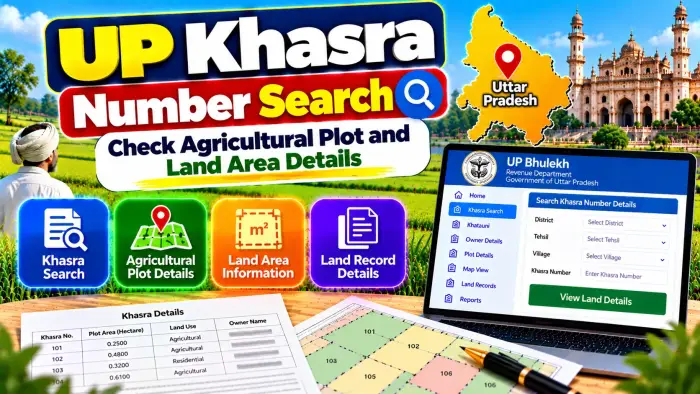
The official UP Bhulekh and Board of Revenue services allow citizens to access Khatauni, Khasra and parcel-related information online. By identifying the correct revenue village and Khasra/Gata Number, users can check available details about a particular land parcel, including its recorded area and associated landholding information.
A Khasra Number is different from a Khata Number. The Khata relates to a broader landholding account, while the Khasra or Gata identifies an individual parcel.
This guide explains UP Khasra Number Search, how to check agricultural plot details, land area, Khatauni, BhuNaksha and other important land-record information.
UP Khasra Number Search – Quick Overview
| Details | Information |
|---|---|
| State | Uttar Pradesh |
| Main Portal | UP Bhulekh |
| Authority | Board of Revenue, Uttar Pradesh |
| Parcel Reference | Khasra / Gata Number |
| Main Record | Khatauni / Record of Rights |
| Khasra Copy Service | Available |
| Landholder Information | Available in applicable records |
| Plot Area | Available in applicable land record |
| Holding Reference | Khata Number |
| Gata Unique Code | Available |
| Sale Status | Available |
| Dispute Status | Available |
| BhuNaksha / Shajra | Available |
| Gata Boundary Information | Available |
| Certified Khatauni | Available through applicable service |
What Is a Khasra Number in Uttar Pradesh?
A Khasra Number is a land-record reference used to identify an individual parcel or field within a particular revenue village.
In Uttar Pradesh's digital land-record system, the term Gata Number is also widely used for parcel identification.
The Khasra/Gata Number helps distinguish one agricultural plot from another and connects the parcel with other revenue information.
A numerical Khasra Number should never be checked without confirming its location. Similar numbers can exist in different revenue villages.
Therefore, always verify the District, Tehsil and Village before relying on a Khasra or Gata result.
What Is UP Bhulekh?
UP Bhulekh is the official online land-record system of the Board of Revenue, Uttar Pradesh.
It provides access to Khatauni or Record of Rights and several parcel-related services.
Citizens can use the system to view land records and investigate information related to a particular Gata.
The Board of Revenue also lists services for viewing Khasra copies, cadastral maps, Gata boundaries and other land-record information.
These digital services make preliminary land verification easier, although important transactions may require additional legal and registered documents.
What Information Can You Find Using a Khasra Number?
A Khasra/Gata Number can help users identify information associated with a specific parcel.
Depending on the applicable record and service, users may be able to check the parcel's recorded area, related Khatauni, landholder information and other revenue particulars.
The Gata can also connect users with additional information such as sale status, dispute status, BhuNaksha and mutation-related records.
Always compare the Khasra information with the relevant Khatauni and property documents.
How to Search UP Khasra Number Online
Start with the official UP Bhulekh or Board of Revenue land-record service.
Select the relevant land-record facility.
Choose the correct District.
Select the Tehsil where the property is situated.
Choose the appropriate revenue Village.
Use the available Khasra/Gata search or record-selection option.
Select or enter the relevant Khasra/Gata Number.
Open the corresponding record and carefully review the available information.
The portal interface may change over time, so follow the current options displayed by the official service.
How to Check Agricultural Plot Details
After finding the correct Khasra/Gata, verify the parcel against the corresponding land record.
Check the Khata Number associated with the holding.
Review the recorded landholder information where available.
Identify the land area shown for the relevant Gata.
If the landholding contains several Gata Numbers, check each parcel separately.
Do not assume that information relating to one Khasra automatically applies to all parcels under the same Khata.
How to Check Land Area by Khasra Number
Land area is one of the most important details to verify when checking an agricultural plot.
Official UP Bhulekh documentation demonstrates records where a Gata/Khasra Number is shown together with the Gata area.
Once you locate the correct parcel, check the area recorded against that specific Khasra/Gata.
Compare it with the area mentioned in your registered deed or other relevant property document.
If several Khasra Numbers are included in one transaction, check each parcel individually before calculating the combined area.
What Is a Khata Number?
A Khata Number is associated with the broader landholding account recorded in the Khatauni.
It is different from a Khasra/Gata Number.
A single Khata can contain multiple land parcels.
For example, a landholder may have several agricultural fields recorded under the same broader holding, with each field identified by its own Gata/Khasra Number.
Therefore, users checking one specific agricultural plot should identify both the correct Khata and the exact Khasra/Gata.
Khasra Number vs Khata Number
The difference is straightforward but important.
A Khasra/Gata Number identifies an individual parcel or field.
A Khata Number identifies the broader landholding account.
If your purpose is to investigate one specific agricultural plot, focus on the Khasra/Gata Number while also confirming the associated Khata.
If your purpose is to understand the broader holding, the Khatauni and Khata Number provide additional context.
Both references are useful for proper land verification.
What Is Khatauni?
Khatauni is the Record of Rights used in Uttar Pradesh's land-record system.
It contains information associated with landholdings and recorded landholders.
A Khatauni can connect the landholding account with individual Gata/Khasra Numbers and corresponding parcel information.
After finding a Khasra Number, checking the associated Khatauni can help you understand how that parcel fits into the broader landholding.
UP Bhulekh also provides an applicable service for obtaining a certified Khatauni copy through online payment.
How to Find Khasra Number If You Do Not Know It
If you do not know the Khasra Number, start with the land documents already available to you.
Check the registered deed, older Khatauni or other revenue documents for the parcel reference.
You can also use the relevant Bhulekh record-search facilities to identify the landholding and associated Gata Numbers.
Once you find the Khasra/Gata, compare it with the Village and Khata details.
Never guess a Khasra Number when researching property.
What Is a Gata Unique Code?
UP Bhulekh provides a facility related to the Unique Code of a Bhukhand/Gata.
The unique code helps identify a parcel within the digital land-record system.
When available, this can provide another reference for distinguishing the correct Gata.
However, users should still compare the unique code with the Village, Khasra/Gata Number, Khatauni and property documents.
A single identifier should not replace complete land verification.
How to Check BhuNaksha by Gata Number
The Uttar Pradesh Board of Revenue provides BhuNaksha/Shajra services for cadastral land maps.
After identifying the correct Gata Number, users can check the applicable revenue-village map and parcel-related boundary information.
This helps provide visual context for the agricultural plot and its neighboring parcels.
UP's cadastral-map digitization system also links many revenue villages and map sheets with BhuNaksha.
However, an online map should not automatically be treated as an official physical demarcation when an exact boundary is disputed.
How to Check Gata Boundary Details
The Board of Revenue lists a service for checking Gata boundaries (चौहद्दी).
Boundary information can be useful when identifying how a parcel is positioned relative to surrounding land.
Compare the boundary or map information with the Khasra Number and available property documents.
If there is a physical boundary dispute with a neighboring landholder, an online map alone may not resolve the matter.
The applicable official survey or demarcation procedure may be required.
How to Check Whether a Gata Has Been Sold
UP Bhulekh provides a service to check the sale status of a Bhukhand/Gata.
This can be useful during preliminary verification before purchasing agricultural land.
Search the correct Gata and review the available information.
Then compare it with the registered deed and current land record.
Do not rely only on one online status when making a significant property decision.
How to Check Whether a Gata Is Disputed
The official portal also provides a facility for checking whether a Bhukhand/Gata is involved in a dispute or litigation.
This is another useful preliminary check for buyers.
However, an online result should not be treated as a complete legal investigation of every possible dispute affecting a property.
For an important transaction, additional registration and legal verification may be appropriate.
Khasra Number and Mutation
When recorded rights change after a sale, inheritance or another qualifying event, the revenue record may require an update through the applicable mutation or नामांतरण process.
If a Khasra/Gata has recently changed hands, compare the current Khatauni with the registered document and mutation information.
A registered deed and mutation are separate parts of property documentation and revenue-record maintenance.
An older landholder name may indicate that further record verification is required.
What If the Land Area Is Incorrect?
First confirm that you selected the correct District, Tehsil, Village and Khasra/Gata Number.
Check whether your document relates to one parcel or multiple Gata Numbers.
Compare the current Khatauni with the registered deed, older revenue records and applicable mutation information.
If a genuine area discrepancy remains, contact the competent revenue or survey authority.
Do not simply choose whichever area figure is more favorable.
Khasra Search Before Buying Agricultural Land
Before purchasing agricultural land, identify every Khasra/Gata Number included in the proposed transaction.
Check the corresponding current land record.
Compare the recorded landholder, Khata and area.
Review the Gata sale and dispute status where applicable.
Check the BhuNaksha for additional parcel context.
Review relevant mutation information, especially if the seller acquired the property recently.
For a significant transaction, also examine registered and other relevant legal documents.
Does Khasra Number Prove Ownership?
A Khasra Number identifies a parcel but does not by itself establish complete legal ownership.
Khatauni and other revenue records provide important information about the recorded landholding.
However, legal title may also depend on registered sale deeds, inheritance documents, gift or partition documents, court orders and other legally relevant records.
Therefore, complete property verification should not rely only on a Khasra Number.
Frequently Asked Questions (FAQ)
1. What is a Khasra Number in Uttar Pradesh?
A Khasra Number is a revenue-record reference used to identify an individual land parcel or agricultural field.
2. Is Gata Number the same as a parcel reference?
Gata Number is widely used in UP's digital land-record system to identify a particular land parcel.
3. Can I check land area using Khasra Number?
Applicable land records can show the area associated with a particular Gata/Khasra Number.
4. What is a Khata Number?
A Khata Number is associated with the broader landholding account recorded in the Khatauni.
5. Is Khata Number the same as Khasra Number?
No. Khata relates to the broader holding, while Khasra/Gata identifies an individual parcel.
6. Can one Khata contain several Khasra Numbers?
Yes. One broader landholding can contain multiple individual parcels.
7. Can I view a Khasra copy online?
The Uttar Pradesh Board of Revenue lists an online service for viewing or downloading an applicable uncertified Khasra copy.
8. Can I check a Gata on BhuNaksha?
Yes. UP provides BhuNaksha/Shajra services for applicable cadastral map and parcel information.
9. Can I check whether a Gata is disputed?
Yes. UP Bhulekh provides a service for checking applicable dispute or litigation status for a Bhukhand/Gata.
10. Does a Khasra Number prove ownership?
No. It identifies the parcel. Complete title verification can also require Khatauni, registered deeds and other relevant legal documents.
Conclusion
UP Khasra Number Search provides a convenient way to check agricultural plot and land area details through Uttar Pradesh's digital land-record services.
A Khasra or Gata Number identifies an individual parcel, while the Khata Number relates to the broader landholding account. By checking both references with the current Khatauni, users can better understand the recorded information associated with a property.
The official system also provides related services for Khasra copies, Gata unique codes, sale status, dispute status, BhuNaksha/Shajra and Gata boundary information.
For important agricultural land transactions, compare the Khasra/Gata details with the current Khatauni, registered deed, mutation information and applicable cadastral records. This provides a more complete understanding of the property than relying on a single parcel number.